Key takeaways
Recommended Actions is now in public preview for retail brands with Unified Transactions.
AI agents in retail often work off one channel's view of the customer, not the whole one.
A recommendation is only as good as the identity behind it, resolved, not fragmented.
Its core strength: spotting high-value customers whose spend is quietly declining before they churn.
Retail marketers already have plenty of AI recommending something. A chatbot suggests the next reply. An ad platform bids on the next impression. Neither one can see that the same shopper is a repeat high-value customer whose spending has been quietly sliding for months. Recommended Actions, Amperity's engine for turning customer data into a prioritized list of marketing plays, takes a different starting point, and it's now in public preview for retail brands with Unified Transactions.
The recommendation retailers already have
Ask five separate AI tools what a shopper needs next and the answers won't agree. Each one is reading whatever slice of behavior it happens to see, a browsing session or a support ticket, never the whole customer. Every answer is defensible on its own and incomplete in aggregate, which leaves someone on the marketing team doing the reconciling work the AI was supposed to have done already.
Resolved identity comes first
Call it a CDP problem if that's the familiar label, but it's really an identity problem. A chatbot and an ad platform can each run strong models, but if they don't share the same resolved view of a customer, their recommendations are built on different customers wearing the same name. Teams leaning on a conversational agent instead of a data foundation often get interaction intelligence, a fast reply, without the customer intelligence behind it.
Amperity's Data Diagnostic, an audit of a retailer's own customer records, found that 56 percent of high-value customer records show up fragmented or misidentified. That fragmentation follows the customer into every tool that touches their data next.
More signals don't fix it. Adding another integration or another model on top of three disconnected records just produces four disconnected records, each more confident than the last. Amperity calls the alternative Contextual Identity: purpose-built graphs from a retailer's own first-party data, resolved into one customer by an engine called Stitch instead of reconciled after the fact.
What AI recommended actions look like on resolved identity
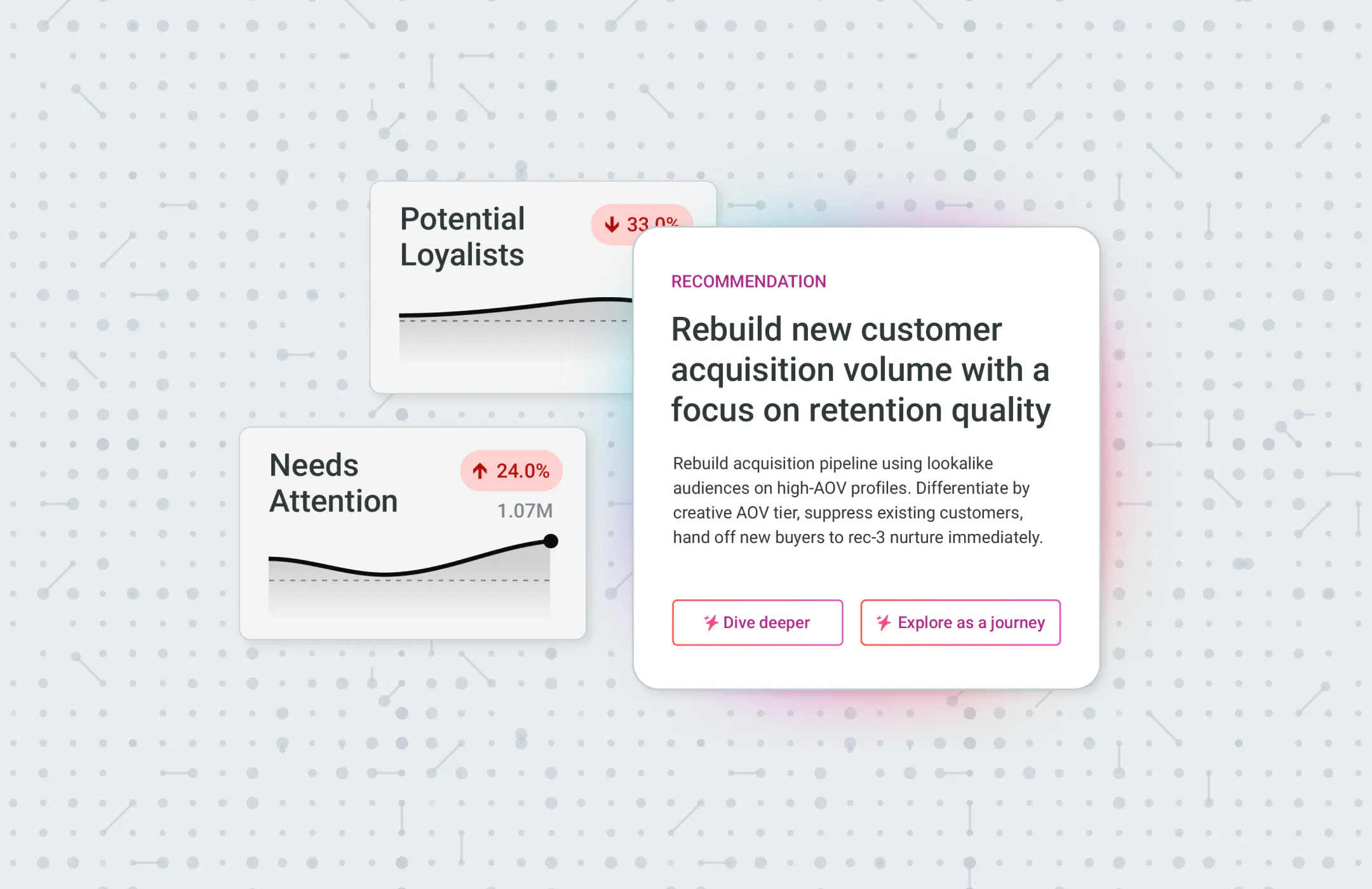
Recommended Actions turns that resolved data into a prioritized list of plays instead of a dashboard someone has to interpret. Each recommendation carries the opportunity behind it and the segment it targets. It also carries the expected business impact, so a marketer can move from insight to activation without waiting on a data team to build the segment first.
Segments come from a value-tier model built on purchase frequency and average order value. A Champion, high frequency and high order value, gets a different play than a customer flagged Needs Attention, someone who spends well but has gone quiet.
The model also tracks how customers move between tiers over time, which surfaces the pattern a churn alert misses: a high-value customer sliding downward while still active. Someone who keeps buying but spends less each quarter rarely trips a churn flag, and catching that quiet decline before it turns into churn is the main thing Recommended Actions finds for you.
Once a marketer acts on a recommendation, its segment moves into a journey or campaign, and reporting shows whether the play worked.
What powers the impact estimate
The expected-impact number on each recommendation is a prediction, not a phrase a chatbot generated. It comes from models trained on a retailer's resolved transaction history.
The AI Assistant, Amperity's reasoning layer, sits on top of that number. It explains why a recommendation was made and can draft the recommendation into a journey a marketer edits and launches. What it doesn't do is invent the estimate underneath.
This release adds one more thing: Recommended Actions can now take custom context from the AI Assistant. A recommendation can reflect a specific business question a team is already working on, not only the standard value-tier model.
Recommended Actions is in public preview for retail brands running Unified Transactions today. The fastest way to see what it surfaces against your own data is to talk to our team.


