Key Takeaways
Event Propensity scores each customer on how likely they are to perform a target event within the next 30 days.
The score only stays actionable inside that window, so Event Propensity serves in-the-moment decisioning, not after-the-fact reporting.
Predictions run on profiles resolved by Contextual Identity and Identity Resolution, which is what makes the scores accurate enough to act on.
Recommended audience sizes and customer ranking turn the score into campaign-ready audiences, from a tight high-propensity segment to broad coverage.
You can usually tell which customers are about to act. The loyalty signup, the co-brand card application: the intent shows up in behavior well before the customer acts. Timing is the problem. A batch report surfaces the pattern days later, once the customer's already decided.
Our Event Propensity model puts you ahead of that decision.
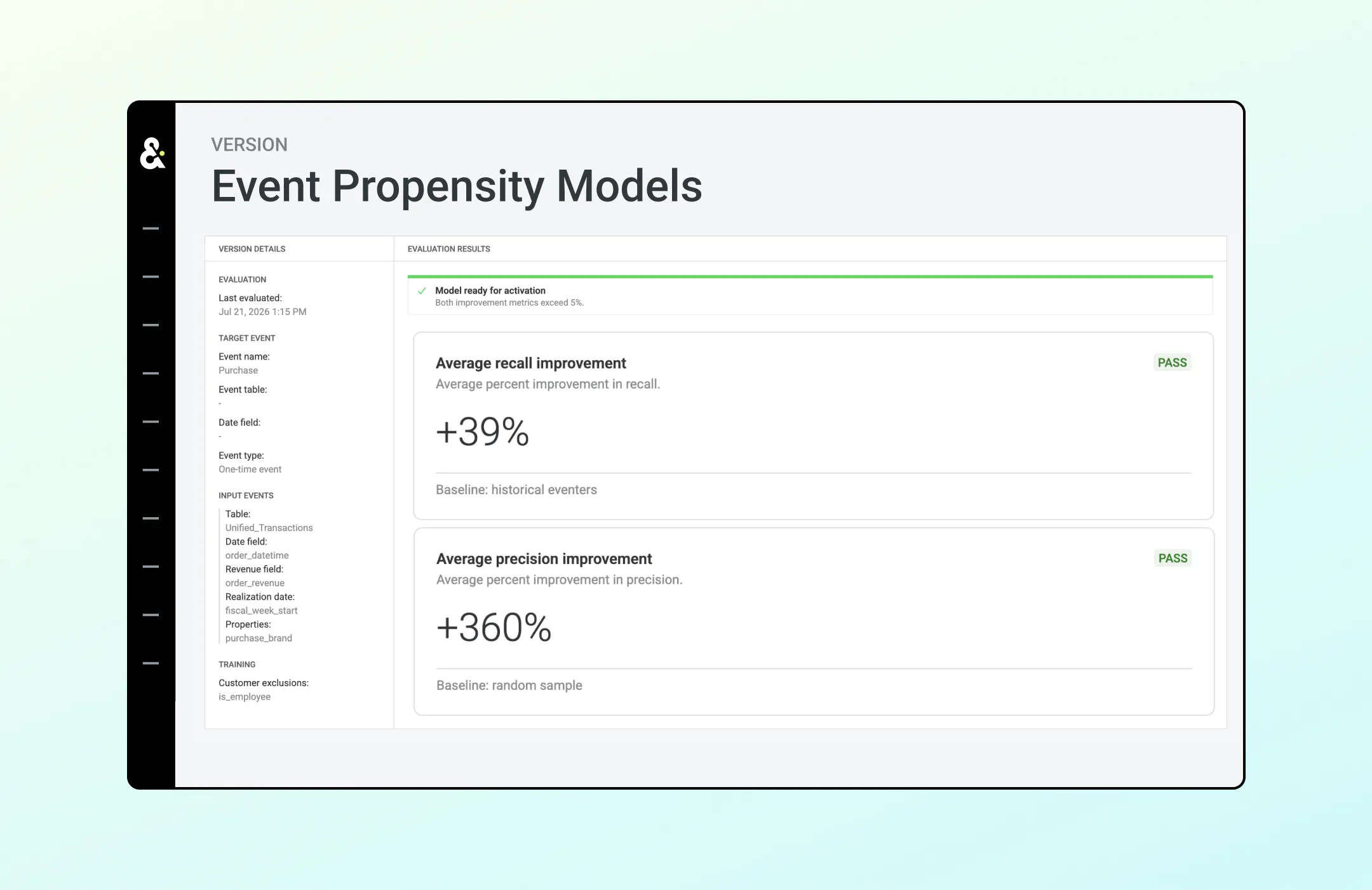
Built on Amperity's trusted customer context, the model scores every customer on how likely they are to perform a specific target event in the next 30 days, then groups those customers by recommended audience size and by ranking to build the campaign audience while the intent's live. The model's available to configure now.
What Event Propensity predicts
The Event Propensity model predicts the likelihood that a customer performs a target event within a 30-day window. That event is whatever drives your business: a loyalty signup, a credit card signup, a repeat booking, an email signup, or a custom event you define. Each model predicts one event and returns a per-customer score, so a marketer builds an audience around who's most likely to act, not who acted last quarter.
Acting inside the window
A 30-day score is only worth having if the team acts before it decays. A customer who looks ready to join the loyalty program this week is a different customer once the trip's booked or a competitor's offer lands. Event Propensity tells you who to reach now, while the decision can still change. Insight was never the hard part. Acting on it in time is.
A prediction is only as good as the identity beneath it
Score a fragmented record and you score a fragment. If one customer exists as four partial profiles, the model rates four strangers, each with a thin slice of the predictive behavior. The output looks confident and points at the wrong people.
Event Propensity runs on profiles already resolved by Amperity's Contextual Identity and Identity Resolution. The model reads one complete behavioral history per customer, so the score is worth acting on. Trusted customer context is what makes the prediction accurate.
Turning scores into campaign audiences
Event Propensity ranks customers and sizes the audience for you. Recommended audience sizes give you three tiers from the same model:
Small: roughly 50% of likely event occurrences
Medium: about 70%
Large: about 90%
Each tier includes the ones below it, so the choice is a spend decision. A small audience concentrates budget on the highest-propensity customers and limits wasted spend. A large one trades efficiency for reach.
Building an audience by ranking
Ranking is the second way to turn scores into an audience: target the top N customers by propensity. Reach for it when the recommended size doesn't fit the campaign, or when a size isn't available for an event. Ranking comes straight from the score, so target on ranking and audience size, not the raw score, which is uncalibrated.
Standing a model up quickly
Data prep is where most predictive models lose weeks. Event Propensity keeps data prep light: the only table required by default is Merged Customers, and you select the event tables during setup. There's no dependency on Unified Transactions before you can predict. For the preset types, loyalty, credit card, repeat bookings, and email signups, the AI Assistant helps you identify the target event table for you.
Start with one target event and one input event, then add signal. Input events that carry revenue, and string properties like tier or region, sharpen predictions. A team can ship a working model early and improve it without rebuilding.
Where teams put Event Propensity to work
The presets cover the events most brands care about: who'll join the loyalty program, apply for the co-brand card, book again, or opt into email. Teams in retail, travel, hospitality, and financial services point the same model type at their own data for a per-customer score in the categories that drive revenue.
Custom events extend the model to anything you can log with one row per occurrence, from a subscription renewal to a first store visit. One-time events earn their keep here: for an event a customer's never performed, like a first loyalty signup, the model learns from other behavioral signals rather than the event's own history, so you predict a first-time action instead of waiting for it. Predicting the next action differs from forecasting a one-time buyer's long-term value, which still calls for business rules.
Get started
Ready to put it to work? If you're on Amperity, configure your first model from the Predictive models page in Customer 360. If you're not, start with a Data Diagnostic to see how resolved your customer data is before you predict on it.