
Building and maintaining a customer data asset that adds value to the business does not have to be a slog of custom jobs.
Key Takeaways
Customer-data modeling is ongoing work because sources, identities, definitions, destinations, and requirements keep changing.
AI can accelerate classification, mapping, code generation, anomaly detection, documentation, and testing, but engineers still own validation and production decisions.
AI creates value when it shortens the path to a reviewable first draft and gives engineers more time for semantics, testing, architecture, and governance.
The strongest outcome is dependable customer data that people and AI can use, not automation for its own sake.
Life could be a lot easier for technical teams in consumer businesses. As data owners, it is their job to make customer data a valuable asset for the business, but many practices remain manual and repetitive.
Customer data is complex. Its volume and velocity span channels, it changes as people and preferences evolve, and its use is subject to privacy and governance requirements. Customer data creates value only when it is accurate, current, secure, and accessible to authorized business teams for appropriate use.
Data modeling and management are never one and done. New sources, destinations, models, requirements, and customer activity create a continuing stream of changes. Customer data assets need ongoing updates and maintenance.
This work becomes time- and resource-intensive when approached manually. Many tools leave data quality and fidelity upkeep to practitioners. Unifying data can require maintaining merge policy, matching logic, custom transformations, and quality tests.
AI-assisted approaches can make parts of data modeling and management more efficient. They can reduce repetitive work, but they do not replace engineering judgment, data ownership, governance, or production validation.
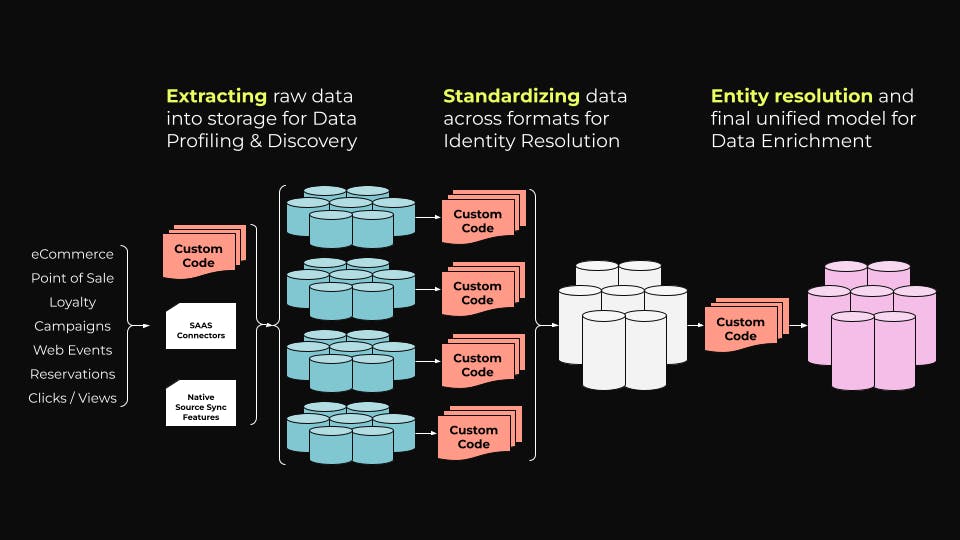 Legacy data refinement needs extensive custom code.
The time cost of data modeling and management
A complete customer-data workflow can include the following jobs:
Connect customer and behavioral data.
Model, standardize, and clean data.
Resolve identities and manage customer graphs.
Merge attributes into fit-for-purpose profiles.
Link resolved identities back to behavior and transactions.
Generate business measures and aggregates.
Build governed views for marketers, analysts, service teams, and other users.
Deliver profiles and audiences to downstream applications.
Monitor and manage change over time.
Each job contains many subtasks, and the workflow changes with source complexity, data quality, business definitions, review standards, and expected change. The practical question is not how long data modeling takes in the abstract, but which steps require original human judgment and which can begin from an AI-generated proposal.
How AI changes the data-modeling workflow
Traditional data modeling requires engineers to inspect schemas, interpret unfamiliar fields, map relationships, write transformations, document assumptions, test outputs, and revise the model when source data changes. Much of this work is essential, but not every step requires the same level of judgment.
AI can summarize schemas, suggest field mappings, identify likely relationships, generate initial transformation logic, draft documentation, and surface anomalies for review. Instead of beginning with a blank page, engineers can begin with a proposed model that they inspect, test, and refine.
The benefit is not automatic or uniform. A clean, familiar dataset may offer limited opportunities for assistance, while inconsistent or poorly documented sources may create more opportunities and demand more careful validation.
Where AI can save time
AI can help classify fields, propose semantic tags, generate transformations, identify suspicious values, draft documentation, create test cases, and explain data-quality issues. Purpose-built identity tools can also combine explicit rules with probabilistic scoring to reduce the amount of hand-coded matching logic.
The clearest gain is a stronger starting point. AI can shift effort away from repetitive discovery and first-draft code generation so engineers can focus on architecture, source meaning, exception handling, testing, and production readiness.
Teams should judge that improvement across the complete workflow. Faster code generation has limited value if reviewers must rewrite the output, errors escape into production, or downstream profiles and decisions become less reliable.
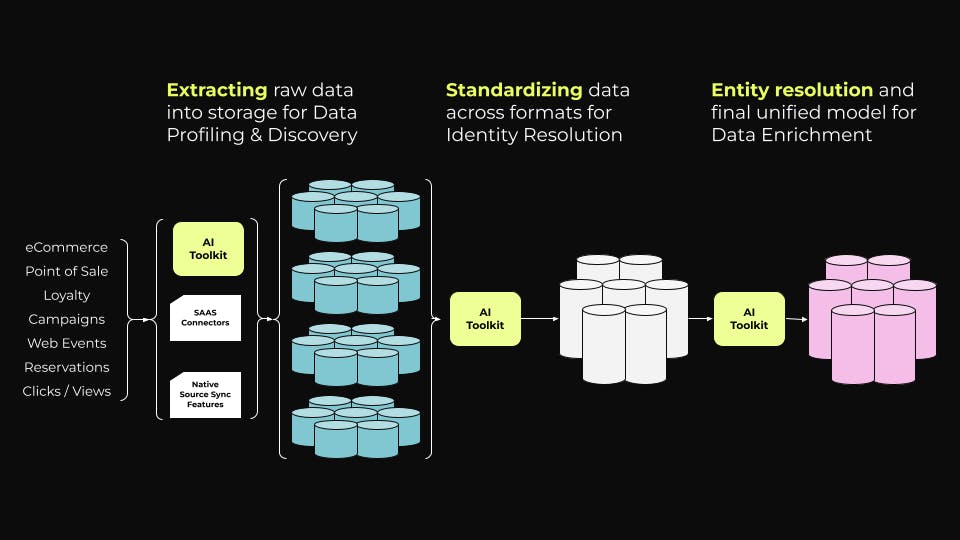 AI tools dramatically reduce custom code to make data refinement faster.
Where engineers still need control
AI-generated models should be treated as proposals, not production-ready assets. Engineers and data owners still decide what each field means, which records and relationships are valid, how business terms map to data, which transformations are acceptable, and what quality threshold a use case requires.
Human review is especially important for identity conflicts, schema changes, model-generated code, privacy-sensitive fields, inferred attributes, destructive transformations, and logic that affects customer eligibility or treatment. AI can reduce exploration and drafting work, but it does not remove accountability for the model.
How to evaluate an AI data-modeling tool
Test it on representative messy sources and known edge cases, not only a prepared sample.
Measure accepted output, corrected output, escaped errors, review time, and production incidents.
Verify permissions, data handling, model-provider relationships, audit history, versioning, rollback, and human approval.
Compare end-to-end delivery and maintenance time, not only code-generation speed.
Track whether downstream profiles, analytics, audiences, and AI decisions become more accurate and reliable.
Build a data foundation people and AI can trust
AI can reduce repetitive customer-data work when it operates inside a governed process with clear source meaning, identity policy, tests, reviewers, and production controls. The goal is faster change without sacrificing accuracy or explainability.
Amperity’s data foundation and identity resolution capabilities help teams connect, model, resolve, and govern customer data while working with existing lakehouse environments. Product behavior and deployment requirements should be validated for the intended architecture.
See how Amperity can reduce repetitive customer-data work while preserving engineering control. Request a demo using your representative sources, identity cases, quality checks, and change workflow.