Key Takeaways
Return on Customer Data evaluates data investments across three core pillars. Businesses must measure how effectively their infrastructure translates customer information into tangible revenue growth, structural cost efficiency, and speed to decision.
High-fidelity profile resolution creates compounding financial returns. Eliminating duplicate customer records expands addressable ad reach, scales precise audience suppression, and optimizes cross-channel attribution simultaneously.
Traditional marketing return calculations fail to capture the cost of inaction. Manual spreadsheet reconciliation and delayed report generation act as a hidden tax on business performance that standard campaign metrics miss.
For many enterprises, customer data has become an expensive paradox. Budgets expand exponentially as data volumes grow, yet business outcomes remain stubbornly flat. Marketing teams struggle with duplicate records, analytics arrive weeks after campaigns end, and personalization efforts still feel like guesswork.
Despite investing in data infrastructure, many organizations can't confidently answer a simple question: Is our customer data actually paying off?
This is where Return on Customer Data (ROCD)™ comes in.
Unlike traditional marketing metrics that measure channel performance or campaign effectiveness, ROCD evaluates how effectively your organization transforms customer data into tangible business value across three dimensions: revenue growth, cost efficiency, and speed to decision.
What is Return on Customer Data?
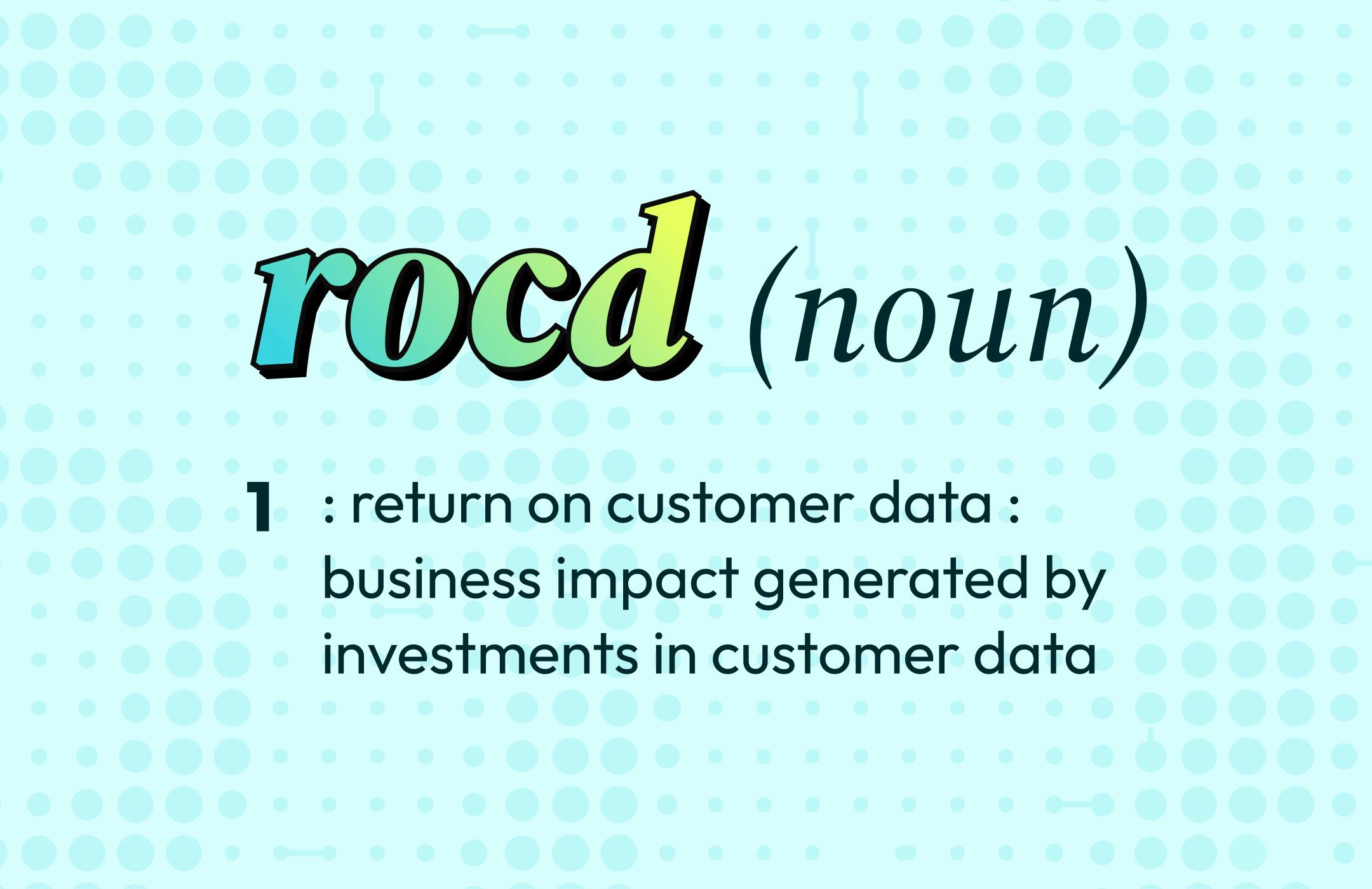
Return on Customer Data measures the business impact generated from investments in collecting, managing, and activating customer data. While similar in concept to traditional ROI calculations, ROCD accounts for the unique characteristics of customer data as a strategic asset that compounds in value over time.
The metric goes beyond simple revenue attribution to examine:
Revenue growth: New customer acquisition, increased purchase frequency, and higher average order values driven by better data utilization
Operating efficiency: Reduced waste in media spending, decreased labor costs from automation, and improved resource allocation
Strategic velocity: Faster time-to-market for campaigns, quicker decision-making from real-time insights, and accelerated testing cycles
Why traditional ROI calculations fall short for customer data
Measuring customer data value differs fundamentally from calculating the ROI of a single marketing campaign or technology purchase. Customer data creates compounding returns that accumulate across multiple use cases simultaneously.
Consider how trustworthy identity resolution ripples through an organization. When you eliminate duplicate customer records, you don't just clean up your database. You expand addressable reach for paid media, enable precise suppression to reduce wasted impressions, improve attribution accuracy, and surface better creative insights. Each improvement reinforces the others, creating exponential rather than linear returns.
Traditional ROI frameworks also struggle to capture the cost of not having good customer data. When marketing teams spend hours manually reconciling spreadsheets, when customers receive irrelevant messages because their purchase history wasn't synced, when strategic decisions wait days for reports, these hidden costs rarely appear in conventional calculations but significantly impact business performance.
The ROCD Maturity Model: understanding where you stand
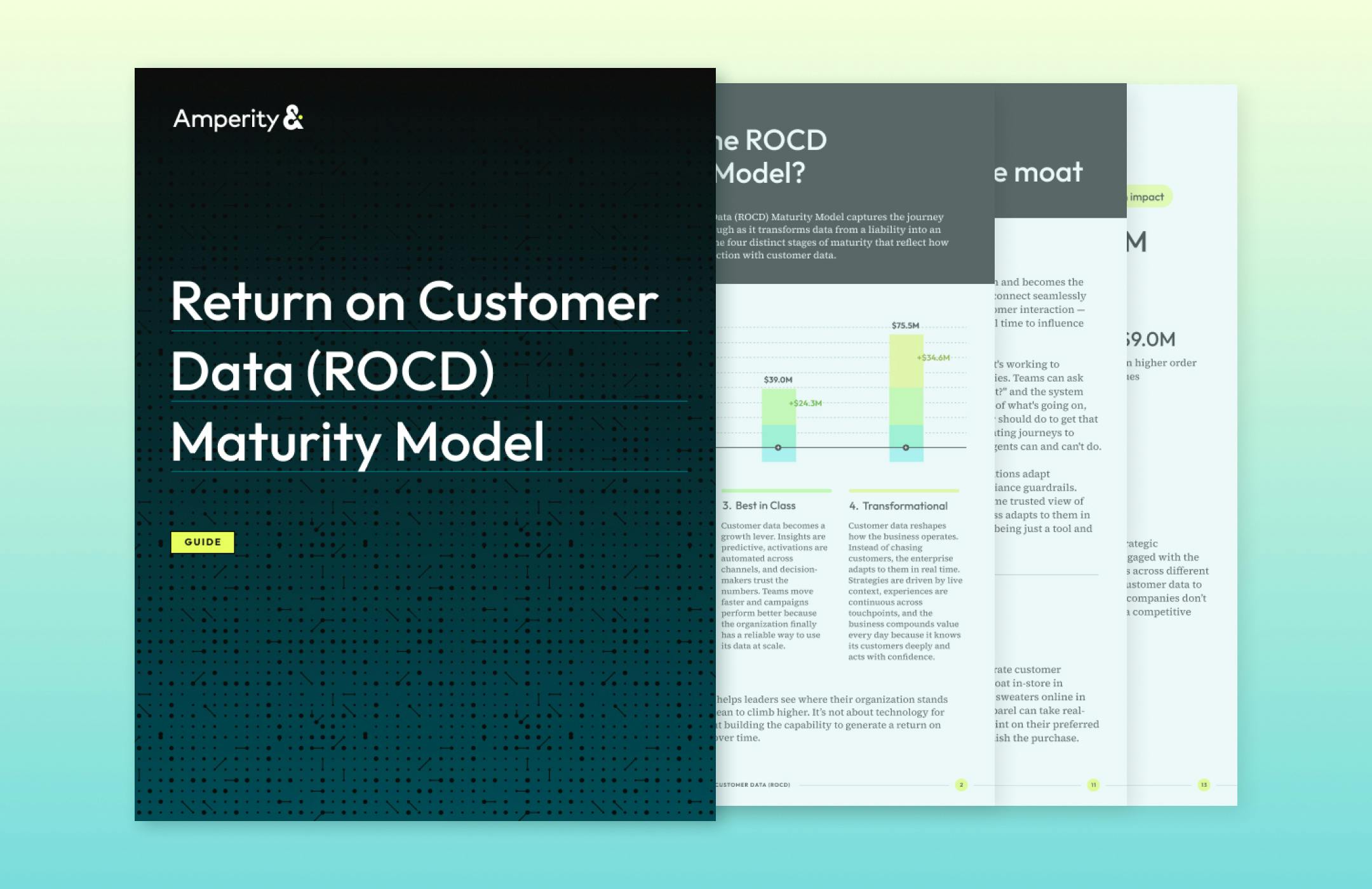
Organizations progressing through customer data maturity experience distinct phases, each characterized by different capabilities and economic returns. The ROCD Maturity Model identifies four stages:
Stage 1: Marginal
Data exists everywhere but delivers minimal value. Teams battle duplicates, wait on batch reports, and manually assemble campaigns using spreadsheets and intuition. Customer data feels more like an anchor than an accelerator. At this stage, organizations struggle to demonstrate any meaningful return from their data investments.
Stage 2: Stable
Data flows reliably to core systems, identity holds together across common use cases, and reporting becomes consistent enough to trust. Campaigns are repeatable, but outcomes arrive unevenly because timing remains batch-bound, insights stay retrospective, and activation follows calendars rather than customer signals. First-party data ROI becomes measurable but limited.
Stage 3: Best in Class
Customer data transforms into a growth lever. Insights become predictive, activations automate across channels, and decision-makers trust the numbers. Teams move faster and campaigns perform better because the organization finally has a reliable system for unified customer data value at scale.
Stage 4: Transformational
Customer data reshapes how the business operates. Instead of chasing customers, the enterprise adapts to them in real time. Strategies respond to live context, experiences remain continuous across touchpoints, and the business compounds value daily through deep customer understanding and confident action.
The economic returns at each stage can be substantial. Based on analysis of a representative $1.5B retail enterprise, advancing from Marginal to Stable generates $14.7M in incremental annual revenue. Moving from Stable to Best in Class adds another $24.3M. Reaching Transformational status contributes an additional $34.6M - for a cumulative gain of $73.5M in annual revenue impact.
These gains compound because improvements in data quality, speed, and activation capability reinforce one another across the organization.
How to measure Return on Customer Data: a practical framework
Measuring return on customer data requires tracking both the value created and costs incurred with precision. While the specific calculation methodology varies by organization, understanding what to measure provides the foundation for proving ROI.
Quantifying value created
Start by identifying revenue gains attributable to improved customer data capabilities:
New customer revenue: Track incremental customers acquired through better targeting, lookalike modeling, and expanded addressable reach when identity resolution improves.
Transaction frequency: Measure increases in repeat purchase rates driven by predictive models that identify churn risk or signal-based activations that engage customers at optimal moments.
Average order value: Calculate lift from personalization, cross-sell recommendations, and dynamic offers enabled by comprehensive customer behavior data.
Beyond revenue, measure efficiency gains:
Media cost savings: Quantify reduced waste from better suppression, improved attribution, and precise audience targeting that eliminates duplicate impressions.
Labor cost reduction: Track hours saved when automated data pipelines replace manual reconciliation, when self-service analytics eliminate waiting for IT support, and when orchestrated campaigns reduce repetitive tasks.
Accounting for total costs
Customer data investment extends beyond obvious technology expenses to include:
Technology costs: Licensing fees for customer data platforms, data warehouses, activation tools, and analytics infrastructure.
Data acquisition: Spending on third-party data purchases, enrichment services, and identity resolution partnerships.
Personnel: Fully loaded costs for data engineers, analysts, marketing technologists, and business users who manage customer data operations.
Infrastructure: Cloud storage, compute resources, and data transfer costs associated with processing and moving customer information.
Opportunity costs: Revenue lost when slow data pipelines delay campaigns, when duplicate records waste media budgets, or when inaccurate customer profiles produce irrelevant experiences.
Establishing your baseline and tracking progress
The key to measuring customer data ROI lies in establishing clear baselines before making improvements, then tracking changes over time. Organizations that successfully prove value follow a consistent approach:
Before improvements: Document current performance across key metrics—conversion rates, customer lifetime value, retention rates, media efficiency, and team productivity. Capture both the hard costs (technology, personnel) and soft costs (manual processes, delayed decisions, customer experience issues).
After improvements: Track the same metrics following infrastructure upgrades, process changes, or capability additions. The difference between baseline and improved performance, minus the cost of the improvements, reveals your return.
Stage advancement impact: The most meaningful measurement comes from tracking progression through maturity stages. Based on analysis of enterprises advancing through the ROCD Maturity Model, organizations can realize incremental annual value ranging millions of dollars.
These improvements compound because capabilities reinforce one another. Better identity resolution enables faster activation. Faster activation surfaces insights that improve identity resolution further. The returns accelerate as maturity increases.
The true power emerges when you track returns across multiple quarters, understanding not just the immediate lift from a single improvement but how strategic investments in customer data infrastructure create compounding value over time.
Key metrics to track for customer data analytics ROI
Measuring customer data value requires monitoring leading and lagging indicators across multiple dimensions:
Identity quality metrics
Match rate: Percentage of customer records successfully linked across data sources
Identity persistence: How long resolved identities remain stable over time
Cross-channel recognition: Ability to identify the same customer across devices and touchpoints
Data velocity metrics
Time to availability: Hours or days from data collection to activation readiness
Integration speed: Time required to onboard new data sources
Refresh frequency: How often customer profiles update with new information
Activation effectiveness metrics
Addressable reach: Percentage of your customer base with sufficient data quality for personalization
Suppression accuracy: How effectively recent purchasers are excluded from irrelevant campaigns
Channel coverage: Percentage of marketing channels able to leverage unified customer profiles
Business outcome metrics
Customer lifetime value: Total revenue per customer over their relationship with your brand
Customer retention rate: Percentage of customers who remain active over time
Revenue per customer: Average annual spending across your customer base
Common pitfalls when measuring customer data investment returns
Organizations frequently make several mistakes when attempting to calculate customer data ROI:
Underestimating hidden costs: Technology licenses are visible, but the hours spent by marketing teams manually cleaning data, waiting for IT support, or reconciling conflicting reports often go unmeasured.
Attributing all gains to data: Not every improvement in conversion rates or customer retention stems from better data capabilities. Rigorous measurement requires isolating the impact of data improvements from other business changes.
Ignoring opportunity costs: The revenue you didn't capture because customers received irrelevant offers, or the competitive advantage you surrendered because insights arrived too late, represent real costs that rarely appear in spreadsheets.
Looking only at direct channel ROI: Customer data creates value across the entire organization - in product development, customer service, merchandising, and strategic planning - not just marketing campaign performance.
Measuring too early: Customer data capabilities take time to mature. Organizations frequently abandon investments before improvements compound, mistaking slow initial returns for permanent limitations.
Improving your Return on Customer Data: where to start
If your organization recognizes itself in the Marginal or Stable stages, three foundational improvements deliver the fastest returns:
Fix identity first: Duplicate customer records undermine every downstream use case. Investing in probabilistic identity resolution that unifies customers across devices, channels, and data sources typically generates 3-5x ROI within the first year through improved targeting accuracy and reduced wasted media spend.
Accelerate data velocity: Every day of lag between when a customer acts and when your systems recognize that action represents missed opportunity. Replacing batch processing with real-time or near-real-time data flows enables signal-based activation that responds to customer behavior rather than following rigid calendars.
Automate activation: Manual campaign building through CSV exports and spreadsheet manipulation doesn't scale. Orchestrated activations that automatically respond to customer signals - browse behavior, back-in-stock alerts, predicted churn risk - deliver higher conversion rates while reducing labor costs.
These improvements reinforce one another. Trustworthy identity makes real-time data more valuable. Faster data enables more sophisticated automation. And automated activation surfaces insights that drive better identity resolution. The compounding effect accelerates as capabilities mature.
Customer data that pays you back
Customer data shouldn't drain resources, it should accelerate growth. The organizations generating outsized returns from customer information investments share a common pattern: they've built the foundational capabilities that allow data improvements to compound rather than deliver isolated gains.
Whether you're struggling with duplicate records at the Marginal stage or looking to reach Transformational maturity, the path forward starts with honest assessment of where you stand today and clear identification of the highest-value improvements for your specific context.
The Return on Customer Data framework provides that clarity, turning abstract conversations about "becoming more data-driven" into concrete roadmaps with quantified outcomes at each milestone. When customer data finally delivers measurable returns, it stops being a cost center and becomes the competitive advantage every digital enterprise needs to win.
To learn more about ROCD or get a personalized demo of Amperity, contact us.