10 Years Toward Agentic: One Journey & What's Next
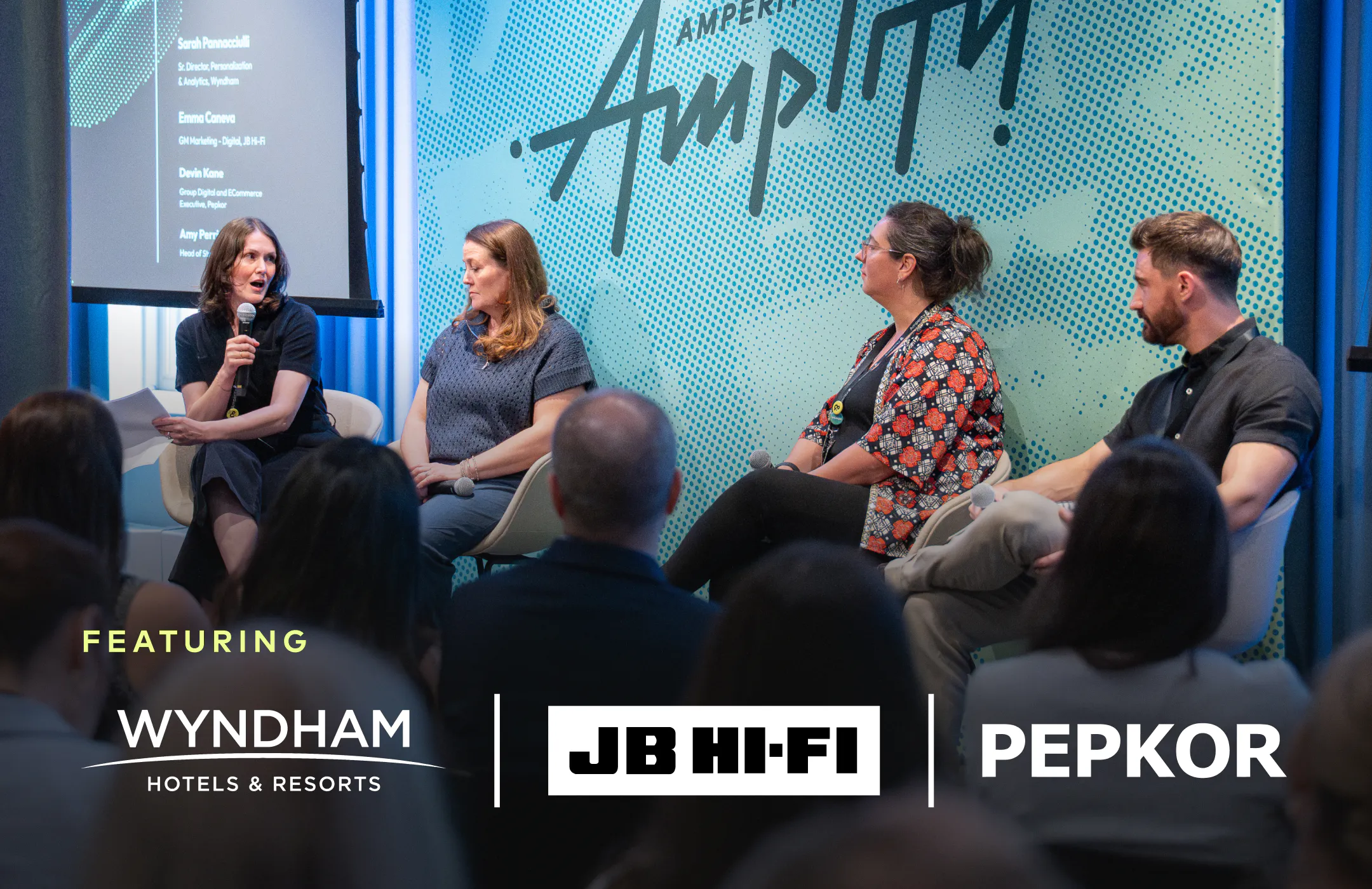
Devin Kane, Digital Executive at Pepkor, shares how one of Sub-Saharan Africa's largest retailers transformed from a business printing 72 million catalogs a year to a data-driven, personalization-first organization on the path to agentic commerce. With Microsoft's Sarah Andrekovich joining for a discussion on the future of AI agents in retail, and Amperity's Matthew Biboud-Lubeck moderating, this session covers the full arc from customer data foundation to enterprise-wide transformation to what selling to AI agents will actually require.
Top Takeaways
Right product, right customer, right time isn't a slogan. It's a business model. Pepkor's printer ink campaign went from a 3x to a 37x return on ad spend overnight, not by offering discounts, but by matching ink products to the exact printer model each customer owned and timing communications to when they were likely to be running low. Their Mac switcher campaign for Apple achieved seven times higher click-through rates by targeting customers only when their existing laptop was statistically likely to slow down or break. The lesson is the same in both cases: relevance at the right moment drives results that broad targeting never can.
A CDP is a cross-functional enterprise asset, not a marketing tool. Pepkor's biggest mistake in their first CDP implementation was treating it as a single-channel solution. Their second implementation changed that. Today Amperity touches customer experience, retail media, product merchandising, demand forecasting, employee capability building, and operational efficiency. The organization went from printing 72 million catalogs a year for 60 million people to a targeted, personalized marketing strategy that saved nearly a million trees while increasing revenue and profitability simultaneously.
Agentic commerce is a new channel that requires a new data foundation. Agents don't browse websites the way humans do. They consume data on an attribute basis, make decisions in milliseconds, and will abandon any purchase journey with friction. Pepkor is already building toward a single machine-readable data layer that agents can transact with directly. As Sarah Andrekovich from Microsoft put it: the strategic question isn't whether agentic commerce is coming. It's what kind of organization you need to build to capture value from it, and how quickly you can get your data foundation ready to compete.

Recommended Sessions: Activation & Growth

Video
From Hype to Habit: How Accent Group Operationalised AI
Moving from AI experimentation to enterprise-wide adoption takes more than enthusiasm. Accent Group introduces The AI Operationalization Loop, a six-step framework for turning prompts into playbooks and theory into operational impact. Walk away with a clear, repeatable roadmap to bring back to your organization.
Video
Activate Your First-Party Data. Capture More Revenue.
Your first-party data can do more than target. Hear from leading brands actively making their data go further — from suppression targeting and conversion optimization to audience monetization — to cut spend and unlock net-new revenue. Walk away with strategies you can act on now.
Video
Turn Fragmented Data Into a Customer Lifecycle Engine
When a leading financial institution unified customer data across a complex, multi-system environment, the goal was never just cleaner records. It was faster go-to-market, stronger engagement, and new revenue. Hear how one leader turned data infrastructure into enterprise-scale business outcomes.
Video Transcript
DEVIN KANE:
Retailers are kind of like blood-sucking mosquitoes in your life — right now, your phone, your laptop, your inbox are all filled with hundreds of irrelevant messages from multiple different shops all begging you to buy. And when you finally give in and do buy, your purchase journey is filled with nothing but friction: UX, inventory, product availability, pricing, shipping, and dreaded returns policies. We're on the path as a retailer from being a parasite, a mosquito in your life, to being a pollinator. I'm Devin. I work for a company called Pepco. I'm from South Africa, as you might already be able to hear. I'm not from one of the pristine coastal towns or the unspoiled wilderness areas you might have heard of. I'm from the wrong side of the tracks — so if you don't understand what I'm saying, just put your hands up and we'll figure it out together.
Also, that headshot was taken two CDP implementations ago. So if you don't want to age like that, listen to my mistakes so you can learn from them. What is Pepco? Pepco is a multidisciplinary retailer in Sub-Saharan Africa and South America. We have about six and a half thousand physical stores, and we sell 13.5 million cellular handsets in a single year. We're powering the next phase of Africa's digital revolution. I manage a number of different teams in the organization, all in the digital and e-commerce space: digital marketing, customer data, web design, e-commerce, logistics, digital analytics, and retail media.
The reality of retail in our market is one that's genuinely challenging in terms of business realities — and some of these are very different to the challenges a retailer would experience in a first-world economy. Government mismanagement, high unemployment, a sluggish economy, crime and security challenges, and aging infrastructure all add to the challenge of our daily operations. The customer realities we deal with, though, are pretty similar to the ones you would experience: lack of legacy customers, no loyalty income, no consumer safety nets, and extreme price sensitivity. Our customers will leave us if another retailer sells the same product for a single dollar less.
Africa doesn't build comfort — it builds character. I was sitting with the Amperity team in a workshop a couple of weeks ago. We were looking at hundreds of different use cases we've implemented with the platform, and also a bunch we want to do going forward. They'd heard a lot of these use cases before, but one raised their eyebrows. This was our hijacking use case. This happens when a truck carrying hundreds of customer orders is hijacked and all of those orders are lost. Those customers have expectations around fulfillment and they don't want excuses. So what do we do? We programmatically identify every order that's been impacted. We then use our tools, including Amperity, to automatically and programmatically communicate with every customer affected by the incident. After that, we source new stock for them, and then we use our tools to manage their expectations and prevent further disappointments. We back this up with a human call center in case they have further queries or concerns.
So we operate in a challenging environment, but our head is in the game and we are ruthlessly focused on taking market share from our competitors. In a market where e-commerce typically runs at a loss, I can't tell you how proud I am to say that we run an independently profitable and rapidly scaling e-commerce business alongside our profitable store business — despite those challenging circumstances. If you're considering Amperity, or you've already bought it, I want to urge you not to implement it in a single silo or to focus only on its marketing or customer data attributes. This is the biggest mistake I made during my first CDP implementation. You need to look at this as a cross-functional implementation across all the different categories and departments in your business, and you need to make sure it's driving each specific sphere of your corporate strategy — not just your marketing or customer data ones.
So I want to take you through our strategy to explain how Amperity is functioning in this cross-functional manner. If you work for us, you wake up and come to work every morning because you want delighted and repeat customers, product leadership, high-performance engaged employees, leading-edge technology, and operational efficiency — from every person, every team, every system, every day.
Let's unpack that strategy, starting with delighted and repeat customers. Now, this is the obvious use case for a CDP — it's probably the first reason most businesses would consider one. I'm going to talk about customer experience optimization and customer journeys, but I don't just want to sound like another suit on stage talking about these things. Yes, it's great to understand the logic and automation capabilities our tools have, but if we don't focus on the inherent human nature of the needs we're addressing, their impact is lost. So I want to take you through two case studies. Both were performed in 2024 using Amperity. I want to show you what the actual impact of this technology was on our business.
The first one involves probably our most boring product: printer ink. Nobody is getting excited or inspired by a TikTok video on printer ink. No one's clicking on an ad or switching retailers because they have amazing ink. It's boring — it's a grudge purchase. You don't need it until 2:00 AM the night before your child's school project is due and your printer isn't working. This situation meant it was a very difficult product for us to advertise and monetize. Our campaigns were previously running at around a 3x ROAS for a product that has between 15 and 20% margin. The marketers in here will quickly be able to work out that those campaigns were not breaking even or making profit, so we needed to do something about it.
We matched the ink products we carry with the exact model of printer that each customer had bought, to make sure they were being advertised relevant ink products. We waited 120 days after each customer bought their printer so we didn't irritate them by marketing too soon. Then we started advertising ink that was relevant to their specific printer. When they bought the ink, we used that timing indicator to calculate their individual replacement timeline, so that going forward we could advertise the right ink for their printer at the time when they would actually need it — when they were likely to be running low. Right product, right customer, right time. The results speak for themselves: ROAS went from 3 to 37 overnight. And I want to highlight that we weren't offering a discount on the product — previously that had been the only way we could sell it. So through additional volume, additional relevance, and reduced customer irritation, we also achieved additional profitability from this use case.
The next use case is a retail media one, because Amperity has also unlocked incremental value in the retail media space for us. I don't want to just focus on gaining additional cash from our suppliers — that really isn't the only focus of our retail media. We want to make sure our customers win, our clients win, and we do as well in the process. Apple is one of our biggest retail media customers, and in our market — like many — one of the key objectives is to switch customers from PCs to Mac. We were running the same messaging as multiple other retailers in our market, explaining to customers that Microsoft Office runs just as well on Mac. The problem with that, in my head, is that Windows machines and PCs run Office really well. There are a lot of different reasons a customer would want to buy a Mac, but those reasons are not going to translate to action unless they're delivered at the time when it actually matters.
Things like design, performance, AI compatibility, status, longevity, and durability are all reasons a customer might buy a Mac. But if they're not delivered at the right time, they're meaningless. Think about your own purchase journey: if you've just spent money on a new PC and it's sitting on your desk, it doesn't matter how great we make the Mac look — you're not in the market. So what did we do? We took customers who'd bought Windows and PC products from us, and we calculated the individual replacement cycles for different brands of laptops. We were able to determine that the laptop you'd bought would be likely to slow down or break at a specific point in time relevant to you. We only targeted customers with Mac switcher messaging at the point at which their existing product was likely to slow down and break. At that point, we tested all of the different messaging angles I just mentioned, to determine the right message for the right customer at the right time.
The results also spoke for themselves. Click-through rates on these ads jumped by seven times, and the campaign achieved one of the highest ROAS percentages of any Apple retail media activity in our business. This is a great example of the tool working for all parties simultaneously: customers got more relevant ads, the retail media client got additional sales, and we got additional profitability and income as a result.
The next phase of our strategy is product leadership. Most people expect me to talk just about merchandising here, but we're actually going to talk about the way in which marketing and customer data teams can work with merchandisers to sell better products. About a year ago, my team started working on a predictive model. It was done in a Google Sheet — relatively rudimentary. We looked at different attributes that would influence the way a product sells in future so that we could source and plan better: stock cover, stock turn, current inventory on hand, pricing, promotions, customer demand, historical demand, and purchase events like Black Friday. We assigned each attribute an individual weighting in the overall formula and let it run. As we got real sales data, we refined the weightings. That report has now become an agent in Gemini that different members of our business can ask questions of and glean insights from.
But Amperity isn't involved yet — and Amperity is going to be involved in the future. Overlaying customer needs, state, and life stage data with our existing product performance data is how we're going to forecast and plan strategically going forward. The next phase of this project is starting to understand that the first-time home buyer of today is the first-time parent of tomorrow and a future potential retiree or college entrant. All of those life stages — and their future life stages — influence the way we should be planning and merchandising our business.
The next part of the strategy is high-performance, engaged employees. You might think I'm going to speak to you about the ways in which we technically upskill our staff to use Amperity, but it's a lot bigger than that. A year ago, our people were asking ChatGPT what to make for dinner. Now they're building their own workflows, creating their own agents, and gleaning insights from data that would previously have required teams of consultants or data scientists. It's only a matter of time before we're sitting in front of one of our staff members and they ask: "Am I building this thing to replace me?" Our answer to that question will test our mettle as managers and our character as humans. And the answer is probably yes — this thing is going to replace you in your current context. But the way in which we prepare you for your future career trajectory is everything right now.
So it's not about teaching you to use a new system. It's about teaching you to glean human insights from that system. It's not about teaching you to put a strategy together — it's about teaching you to implement and operationalize it in a business context. That's the future of our engagement with our employees, and it goes far beyond a technology perspective.
The next phase of the strategy is leading-edge technology. Like most retailers, we're really excited about agentic commerce right now. It's a really exciting roadmap. There are a lot of different players in the space, everybody's launching protocols from one week to the next, and nobody knows who the dominant players are going to be. Because of this, we want to build a multi-cloud, multi-agent, protocol-agnostic enterprise architecture — which basically means we want the freedom to scale and change in the future as technology changes. The way Amperity fits into this is through its lakehouse, headless approach to data management. This basically means that any external system will be able to read or write data in Amperity as if it were just another cloud, which makes it really quick for us to integrate with new systems or providers when they become prominent. And it doesn't force us to commit to a single provider or stack right now.
This is also true for our activation points. I was sitting with our previous CDP provider about four years ago. TikTok was the fastest-growing social media channel in our market and globally, and I was asking them to create a connector so I could move customer data between the CDP and TikTok. It took them four months to build the connector. Hundreds of developers were involved, and in the process we lost our first-mover advantage in our market, which cost us countless sales and customer engagements. I know that's not going to happen to me again because of how quick, cheap, and easy it is for a new activation point to integrate with Amperity.
The final point in the strategy is operational efficiency — and there really is only one stat here. Before we started our personalized, targeted marketing strategy with Amperity, our tech brands used to print 72 million catalogs a year. There are only 60 million people in South Africa. In the two years that we've been running our new strategy, we've saved nearly a million trees, we've delivered more efficient marketing, we've responded to our customers' needs, and we've increased sales revenue and profitability as a result.
So you can probably already see that we're transforming our business from the mosquito in our customers' lives to the honeybee. What's next is our agentic commerce strategy, and we're incredibly excited about what's going to happen. We know that we've chosen the right CDP partner to scale and innovate into the future. Thank you.
MATTHEW BIBOUD-LUBECK: Thank you — that was amazing. I'll have Sarah come and join us. She's a good friend of mine and also our Microsoft partner for retail and CPG: Sarah Andrekovich. I'll let you introduce yourself briefly and talk about the work you do.
SARAH ANDREKOVICH: Sure. Sarah Andrekovich, nice to meet you all. I'm based out of New York City. I am our industry retail and consumer brand lead, and I lead our marketing and product innovation practice. Glad to be here.
MATTHEW BIBOUD-LUBECK: Amazing. What a great segue — just looking at everything that Pepco has been able to accomplish and the foundation they've built, it's a perfect segue into agentic. You can imagine we've spent the whole day talking about how you need the data to be able to move toward an AI future. Obviously we've got the data. You're sitting at Microsoft, probably one of the most important companies at the intersection of the AI roadmap today. Can you unpack for us the Microsoft point of view on what agentic actually is? And I know no one loves to predict far into the future, but can you look into a crystal ball and tell us what you think the future looks like?
SARAH ANDREKOVICH: I'll start with a definition. In layman's terms, the easiest way I can articulate it is: AI gives you answers, agents are the doers. And with agents there's a maturity — they are reasoning, planning, and taking action on your behalf. You're going to have a myriad, an ecosystem, of these digital employees working within your organization alongside your human employees. We like to look at this as more of a ten-year maturity arc than a switch overnight. You don't build an organization in a day, and you equally cannot build agents in a day. So we look at the strategy and the maturity of that arc. The vision is what we at Microsoft call frontier firms.
SARAH ANDREKOVICH: What we mean by that is that every marketer is going to be an agent boss. And what does an agent boss do? They direct, they provide guidance, they give strategy, they set guardrails. Just as you would manage a team, you're now managing a hybrid workforce of digital and human employees. And what we like to say is: you're still leading and owning the output of that work. You're also responsible for managing the agents — what data is provided to them, the context they're given, and how you continue to train and elevate what they do. As you think about the progression toward that frontier, organizations will eventually adopt this hybrid model.
SARAH ANDREKOVICH: We call this "human in the lead." So back to the question of whether agents are going to replace your role in its current context — possibly. They'll replace tasks, they might replace workflows, but all you're really doing is elevating your team to do more at scale. What agents provide is scalability without incremental resourcing, and I think that's incredibly valuable to the frontier organization. The gap today is that most folks are still treating AI as an assistant — which we consider phase one — all the way through to phase three, where agents are taking action on your behalf. And that's okay. The good news is there's a payout at every phase. You're stacking value as you go. You're getting value from day one, not year ten.
MATTHEW BIBOUD-LUBECK: The potential productivity gains are kind of amazing. Take the printer ink example — it's very clear you're sitting in a business strategic enough to make big moves, but you only have so many people. I would imagine that agentic lets you take that creativity and exponentially scale what's possible. Unpack that for me — now that you've done this foundational work, how are you starting to prepare or even deploy agentic within Pepco?
DEVIN KANE: It's a six-step answer, and I want you to listen to how many of these steps involve people and processes, and how few actually involve tech. The way we've defined it: first, building our data foundation — and as you heard from the previous presentation, we've done a good job there. Then we're scaling our agnostic enterprise architecture, which is really the phase we're in at the moment. Then teaching analytic abilities to our staff, because it's one thing to have access to data and agents — it's another to know how to prompt them correctly and understand their responses in the context of your business questions. An agent is only as good as the prompt it receives. Then democratizing data access and agent creation.
DEVIN KANE: We don't want these things sitting in silos anymore. We don't want people asking a question of a data scientist or an external team and then waiting days or weeks for an answer that may or may not be useful to them in their specific use case. We need to have that data democratized. After that, we're aligning individual KPIs with technology output — making sure people have KPIs in their job profiles related to their use of agents and AI to be better at their jobs. Then — [brief technical interruption] —
MATTHEW BIBOUD-LUBECK: The agents didn't like the answer and they cut us off.
DEVIN KANE: And the final point of the strategy is how we're testing and refining our security and privacy procedures. It's one thing to say we want data democratized — it's another to say we trust the people and destinations that are going to be using it and that they're going to keep our business safe. This whole process is a lot less about the tech strategy and a lot more about the processes and people involved, because that's actually where the big change needs to happen.
MATTHEW BIBOUD-LUBECK: You teased us a little bit with agentic commerce. First of all, what is it to you, and what are you doing about it?
DEVIN KANE: The basic idea is that we're going to be selling goods to agents instead of people in the near future. That's really exciting, because agents don't process or decide on data in the same way human beings do — and it's going to represent an enormous opportunity for us. As you heard in the previous presentation, we really value being first movers and innovators in our market because we've seen that we can win additional customers from competitors when we do so. So we're going to have to change the entire data foundation of our business, and we're also going to change the way we market.
DEVIN KANE: By "data foundation," I mean the way the web is currently built. Almost any website you access right now is built in three different layers: a content layer, an interaction layer, and a transaction layer. The content layer is the stuff you see on the front end — the nice images, the pretty pictures. The interaction layer or middleware covers things like search, navigation, filters, carts, and so on. The transaction layer is identity, delivery, and payment service providers. Customers are used to interacting with this and are used to waiting a couple of seconds for these layers to talk to each other as they complete a purchase. An agent will not be nearly as patient, and as a result, websites in their current form will slow agents down and frustrate them. So what we need to build is a single machine-readable data layer that can provide agents with every insight or piece of data they need to make a purchase decision.
DEVIN KANE: The things agents are going to do are pretty similar to what humans do. They need to understand what product is being sold, be able to compare it across different retailers or options, decide on a product, and then transact — including paying. We need to make all of this data accessible so that they can do this within milliseconds and transact with us. We know that if we do that we'll have a competitive advantage over competitors who do so more slowly. The second point is that we have to change the way we market. Marketers here will remember the bugbear that SEO was when it originally came out, and how we were all stuffing webpages with metadata to try to rank for customer search terms. The way agents consume data is different from how humans use search engines.
DEVIN KANE: Agents consume data on an attribute basis. They understand the needs of the human who put in the prompt. They'll understand that this human has a child with a birthday party, or is a student studying late at night, or is a pet owner who needs dog food. The attributes around those products are going to help agents make recommendations far more efficiently than metadata or front-end content will. So we need to create an additional layer of agent-readable attributes that will match their queries, so that our products rank more frequently in agent results and can be purchased more easily.
SARAH ANDREKOVICH: I was just going to add to that — I feel like we've switched roles. You were talking about the tech and capabilities, and I'm about to pull it back to what this means for leaders. We talk to CMOs, CDOs, and COOs often, and I think the question becomes: in my mind, this is a new channel. What's the potential of this new channel in driving sales? Just as you create a channel strategy and articulate the value proposition for your products — what your online versus in-store strategy looks like — the same goes for the agent world. He's talking about how do you enable the agent world, and I think everybody might as well get started with brand agents on their own website, if you haven't already — or at least explore conversational search on your own website.
SARAH ANDREKOVICH: But back to human in the lead — there's still a strategic question about what kind of organization you set up to enable agentic. Agentic still doesn't know its place in most organizations, and the question is: where's the value, what is the sales contribution that's going to come from this net new channel? Those are still the same questions we had during COVID when we were debating what percentage of sales would eventually be online. I think we're still in that evolution phase with agentic commerce, and that's what leaders are more or less grappling with today.
MATTHEW BIBOUD-LUBECK: I love that. And there's also the change management piece. We're talking about sophisticated concepts and making them feel simple, because we're just dialoguing in a room here — but actually there are hundreds if not thousands of people in these organizations who need to somehow operate and make these transformations, whether around how they use customer data or how they interact in commerce. And it's not lost on anyone that asking all those people to log into a thousand tools is probably not the answer to quick change management. We need to make this simple. So maybe we take it to you, Sarah — thinking about the world of Microsoft and tools like Copilot: a lot of people here saw the demo this morning of how Amperity might integrate with some Microsoft products. But broadly, Copilot will fall down if it doesn't have the right data, if the data is ungoverned, or if the quality isn't there. How do you think about the world of Microsoft as an interface, with Amperity or other tools accessing the right data to make people's workflows simpler?
SARAH ANDREKOVICH: I'll use this as my pitch to Devin who mentioned Gemini and AWS — but Microsoft. We'll see how this works. Microsoft as a whole: Copilot is what we call your UI for AI. We don't like to take every function out of its own user interface. Your creatives are going to sit within the Adobe ecosystem — that's where they naturally operate. The majority of your enterprise colleagues are going to be sitting in what we call Copilot, which is your chat interface. For Microsoft, we are a platform organization. We are not a model provider. The point being: models will evolve over the next decade or two, and we are not here to tell you which one is better. We're here to give you the optionality, and to be able to surface those models, those agents, those AI answers within one user interface so that you're not opening multiple different apps to do your work.
SARAH ANDREKOVICH: What that enables you to do as an individual is productivity gains. But what it then enables is the cross-functional workflows we've been talking about. If you're asking Copilot for your customer segment — "give me my top sellers in certain markets" — you can pull that into a PowerPoint and be prepared for your QBR or your Monday meeting. The idea is that you're doing all of that through one interface. Partners like Amperity will have what we call plugins so that you can get access to their apps, their capabilities, and most importantly their data — and within Microsoft you're surrounded by the security, the governance, and the contextualization. We've got tools — and I won't go into all the nuances — but Fabric and IQ theoretically layer in all of this data and orchestrate it across not just your CDP, but your DAM and your CRM tools as well. We're not replacing those either. And then you're giving your people access to that data. I like to call it BI to DI with AI — you're not drowning in business insights dashboards, you're now working with decision intelligence that is active, real-time, and dynamic, and exportable into whatever tool you need.
MATTHEW BIBOUD-LUBECK: That's amazing, because you're getting a bunch of things at once. You're getting all the governance you need, the ability to distribute data into the organization, but you're also getting simplicity in terms of workflows. We all know how to log into Teams or use Microsoft Word or PowerPoint — instead of integrating into yet another tool. That's so powerful.
SARAH ANDREKOVICH: Said beautifully.
MATTHEW BIBOUD-LUBECK: I think everyone is wondering — following up on the earlier presentation — about the hijacking use case in South Africa. Are the truck drivers okay?
DEVIN KANE: Most of the time. Remember what I said about character.
MATTHEW BIBOUD-LUBECK: We've got a little bit of time for Q&A if there are questions for Devin or for Sarah.
AUDIENCE MEMBER: What are the friction points you're seeing in driving that BI to DI using AI? I really like the punchline. What are the friction points from a use case perspective, at different levels?
SARAH ANDREKOVICH: I think we have different tierings of process and workflow. We often talk about the overall workflow — level one — and the tasks associated with those workflows at level two. Most organizations don't have a clear understanding of what their current-state flows actually look like. What I've been advising most of my customers, and what we're actually doing in real time for our next fiscal, is: now that we have access to some of these AI capabilities, how do we reimagine our engagement with customers? And I think it comes down to: what does the current state look like? Truly map it at each of those levels. Because then we can apply AI on top of that and say, where are the biggest friction points based on your current state?
SARAH ANDREKOVICH: Then it becomes a dialogue. Everybody is going to have their own friction points at different levels of that tiering. So how do you create a common language for everyone to articulate what those friction points are? I call them stage gates. What are your stage gates within every workflow, what are the decisions you're trying to make, and what data are you trying to make them with? That's how you start to define the AI tooling you'll need within that, and what pain points or problems you're solving for. So I'd say: start with your current state, and also get a clear understanding of what tooling is currently in use — because most organizations don't have that written down in any depth.
MATTHEW BIBOUD-LUBECK: Great. A couple of key takeaways and thank you both so much. From Devin, the call to action is clear: get your customer data foundation right, and get it right upstream enough in your architecture that it can really impact your whole enterprise — everywhere that customer data is required. That really is the future. You can see the impact Pepco is now making by having that foundation — their readiness and ability to speed toward agentic is pretty incredible. And from Sarah: while we're in the current phase of agentic, which is really more about AI as an assistant, we're moving very quickly to a place where agents are going to help us scale the work we do. New tooling is coming to make it easier than ever to distribute access to data across an organization, and to make it simple for people to actually use data in their jobs in a way that's never been possible before. The story is pretty clear. Thank you so much for your partnership, and thank you for flying all the way from South Africa. And thanks to all of you.