Customer segmentation built around your next campaign
Choose who to reach using resolved profiles, purchase history, and the customer attributes available to your team. Build and review audiences in Amperity, then send them to configured marketing destinations.
Request a demo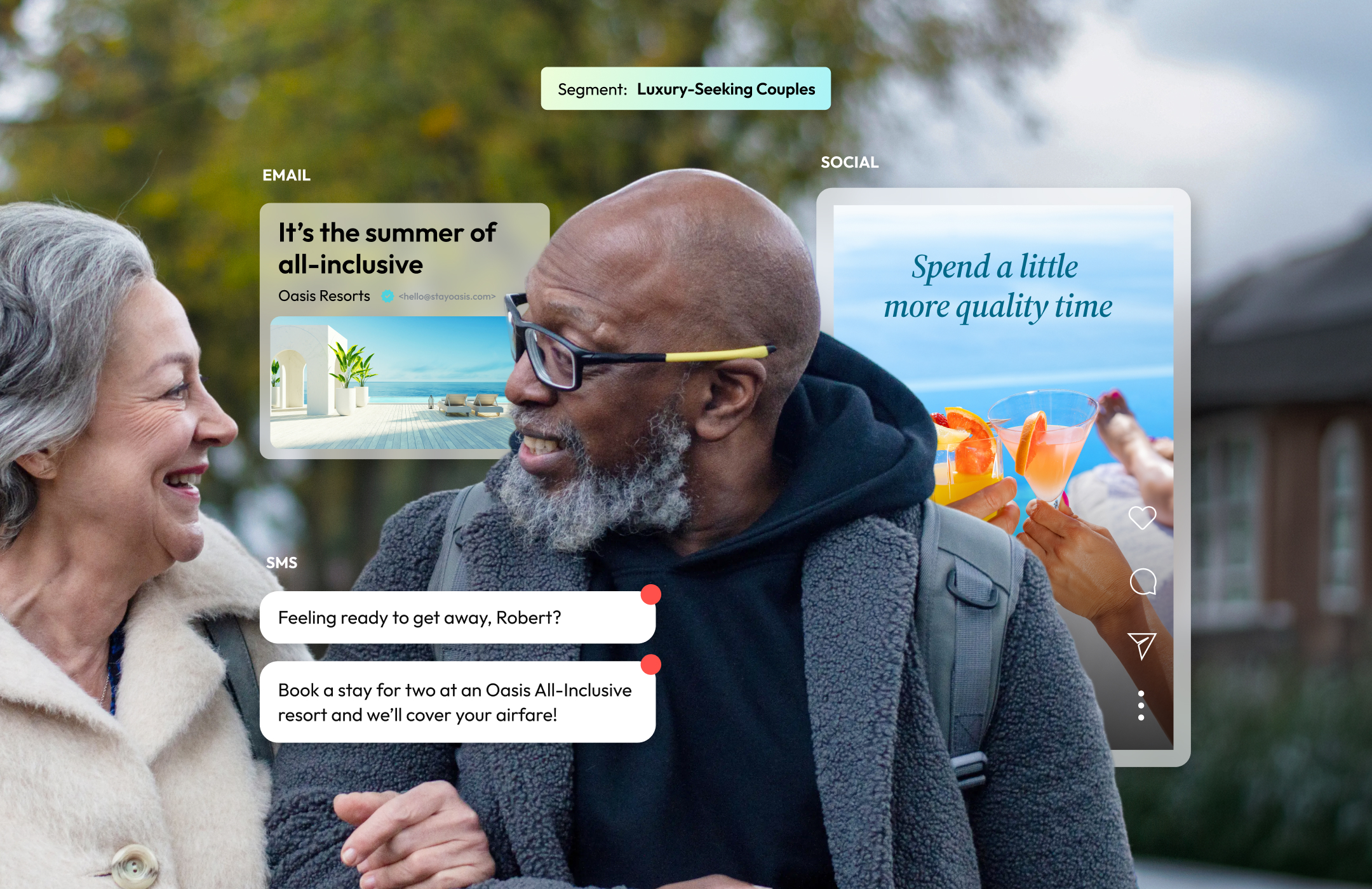
Customer segmentation for more relevant campaigns
Prioritize audiences for growth
Use purchase history and configured predictive attributes to find audiences for cross-sell and repeat-purchase programs. Test which offers and treatments work for each group.
Plan retention around customer behavior
Combine available lifecycle, value, and engagement attributes to identify customers for retention programs. Use those audiences to tailor loyalty and win-back outreach.
Manage overlap and exclusions before activation
Compare segment overlap and define who to include or exclude from a campaign. Apply configured audience rules across supported destinations to reduce conflicting outreach.
Move from an audience question to a reviewed segment
Give marketers tools to explore customer data, define an audience, and check its size and composition before activation. Technical teams configure the data and destinations those workflows depend on.
Put precise customer segments to work across high-impact use cases

Re-engage high-value customers before they lapse
Use available purchase history, engagement, and predicted value to identify customers who may be disengaging. Define separate retention and win-back audiences, then configure journeys around each group’s needs.

Align loyalty journeys with customer status
Build loyalty audiences using the points, tiers, and engagement attributes available in your profiles. Choose batch or real-time segmentation according to the data and timing your journey requires.

Suppress recent purchasers and manage audience overlap
Define recent purchasers as an exclusion audience for acquisition campaigns where that approach fits your strategy. Deliver updates through configured destinations on the cadence each workflow supports.

Find more customers like your best customers
Create seed audiences from resolved customer profiles, using value and predictive attributes where configured. Send those audiences to supported ad platforms for their lookalike or audience-expansion workflows.
From trusted customer context to coordinated activation, end to end
Build audiences on trusted customer context
Amperity resolves identity across the customer data you connect. Use a unified customer profile to bring available history and attributes together before deciding whom to reach.
Create segments with the tools your team needs
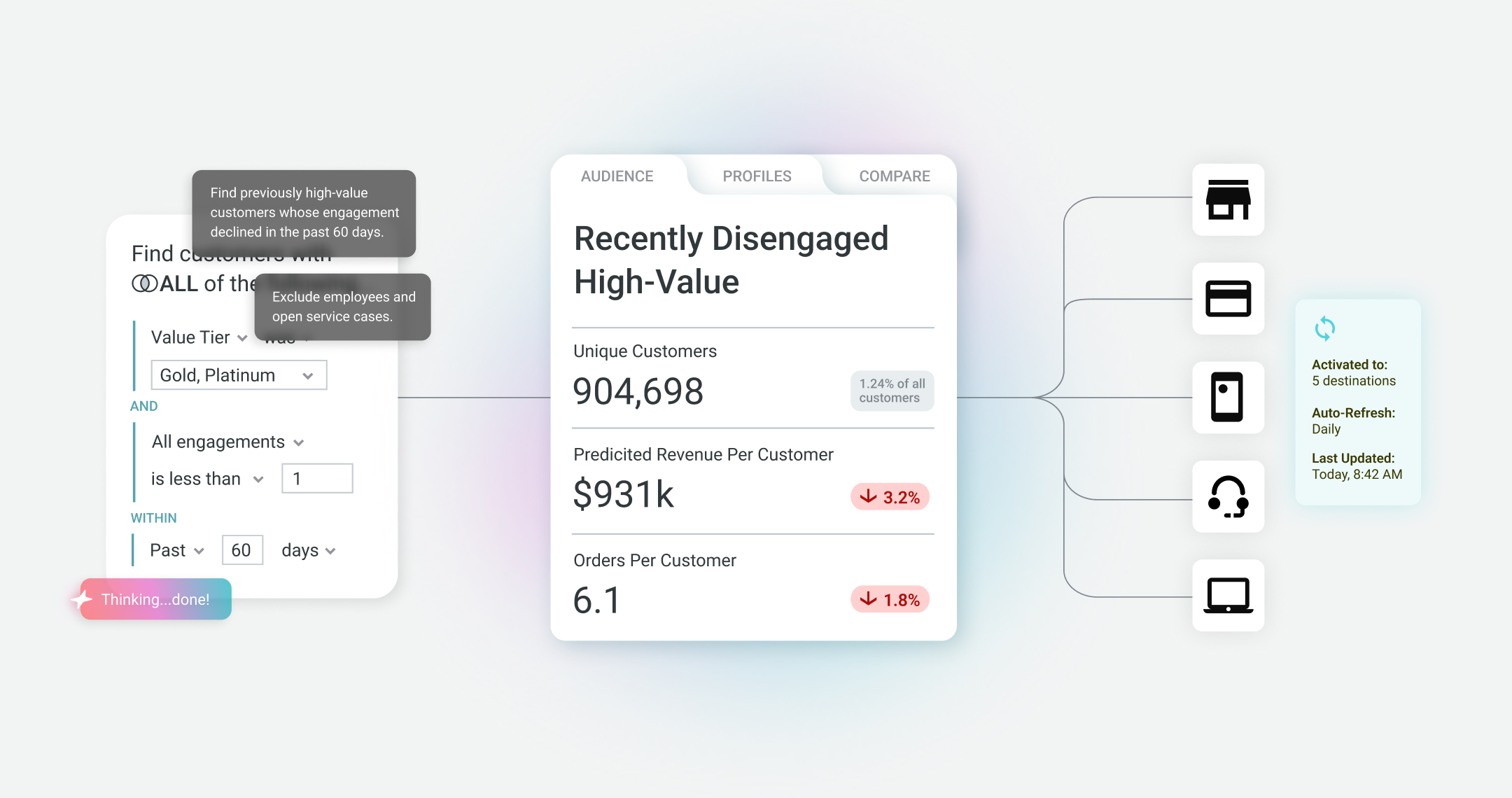
Use the visual Segment Editor to define audiences without SQL, or use SQL for more technical requirements. Where available, the AI Assistant can draft segment criteria in natural language for you to review, refine, and save.
Understand audience value before activation
Inspect audience size, historical revenue, attribute breakdowns, and overlap using configured segment insights. Use those findings to review targeting choices before sending an audience to a campaign.
Keep audiences current through configured workflows
Database segments produce an audience when they run, using the data available at that time. Real-time segments maintain membership as events update profiles. Send audiences through the activation workflows and destinations configured for each use case.
Find your next audience with Pér
When enabled for your team, Pér, Amperity’s AI agent for customer data, helps you explore audience opportunities using data available to you. It can propose audience-building work for your review and approval before making changes in Amperity. Browse the prompt library for a starting point, then adapt the question to your campaign.
Explore Pér promptsReal results from smarter customer segmentation

BECU
Amperity helped BECU unify 37 data sources and turn 297 million records into 4.1 million profiles across its business lines. BECU reports saving more than 50 hours each week on outbound execution.
Read the BECU story
Servco
Servco brought fragmented customer data together with Amperity to support marketing and business insights.
Read the Servco story
Luxury retailer
An anonymous luxury retailer reported 439% better segmentation results with Amperity’s CLV model and identified more than 16,000 new purchasers.
Read the luxury retailer storyMore ways to put customer context to work
Customer Journey Orchestration
Coordinate lifecycle journeys with audience rules, configured steps, and supported destinations.
Real-Time Personalization
Give connected experiences customer context from real-time profiles and supported event signals.
Loyalty & Retention
Prioritize retention opportunities using customer history, available predictions, and program results.
Paid Media Optimization
Send first-party audiences and supported conversion signals to your connected advertising platforms.
Ready to see customer segmentation in action?
Request a demo and see what better segmentation looks like for your data, your stack, and your team.
Request a demoContact SalesFrequently asked questions
What is customer segmentation?
What are the main types of customer segmentation?
What is the difference between customer segmentation and audience building?
Why does identity resolution matter for customer segmentation?
How does Amperity make customer segmentation self-service for marketers?
How do self-updating customer segments work?
Recommended Content

Blog
Nov 2, 2026
CDP Migration: How to Preserve Customer History and Workflows
Plan a customer data platform migration around history, identity, eligibility and destination behavior, with validation before cutover.

Blog
Oct 30, 2026
How Much Does a Customer Data Platform Cost? A Total Cost Breakdown
Understand customer data platform cost beyond the license: implementation, usage, storage, integrations, staffing and migration.

Blog
Oct 28, 2026
How to Run a CDP Proof of Concept That Answers the Right Questions
Design a CDP proof of concept using your data, identity-quality checks and destination tests. Define the evidence your buying decision needs.