
Lakehouse CDP built for the warehouse you already have
You've already invested in Databricks, Snowflake, BigQuery or AWS. Amperity works with that lakehouse, not around it. With Bring Your Own Compute enabled, supported batch workloads can run on your Databricks compute. With Bring Your Own Storage enabled, Amperity stores supported data in your own Amazon S3 bucket or Azure Blob Storage location. Resolved customer context lands where your teams already work.
Request a demoDownload guideComposable, governed, and built for enterprise scale.
Govern data where it already lives
With Bring Your Own Compute enabled, supported batch workloads execute in your Databricks environment, where your existing security and governance controls apply to them. Lineage shows where customer data is stored, processed and accessed, so your team can review it.
Customer data governanceProtect the investments you've already made
Regulated data stays in approved regions and customer-controlled environments. Amperity aligns to your compliance requirements rather than asking you to carve out exceptions, so global and regulated teams fit Amperity into their obligations without rebuilding what already works.
Reduce complexity without sacrificing flexibility
Zero-copy where possible, reduced-copy where necessary. Fewer data movements mean fewer synchronization failures, better latency, and less infrastructure to maintain across supported workloads, without limiting how your teams connect Amperity to the rest of your stack.
Power AI with trusted customer context
Your data science, analytics and AI teams keep working in the tools they already use. Amperity-resolved customer context can reach Databricks and other connected environments, with no new operational data plane to adopt first.
The heavy data work can run in your environment. Amperity manages the downstream experience: orchestration, activation, and real time.
With Bring Your Own Compute enabled, identity resolution and other supported batch workloads can run on your Databricks compute, while we manage real time and activation. Your data and engineering teams avoid redundant copies and keep the freedom to connect new tools without rearchitecting each time requirements change.
Technology teams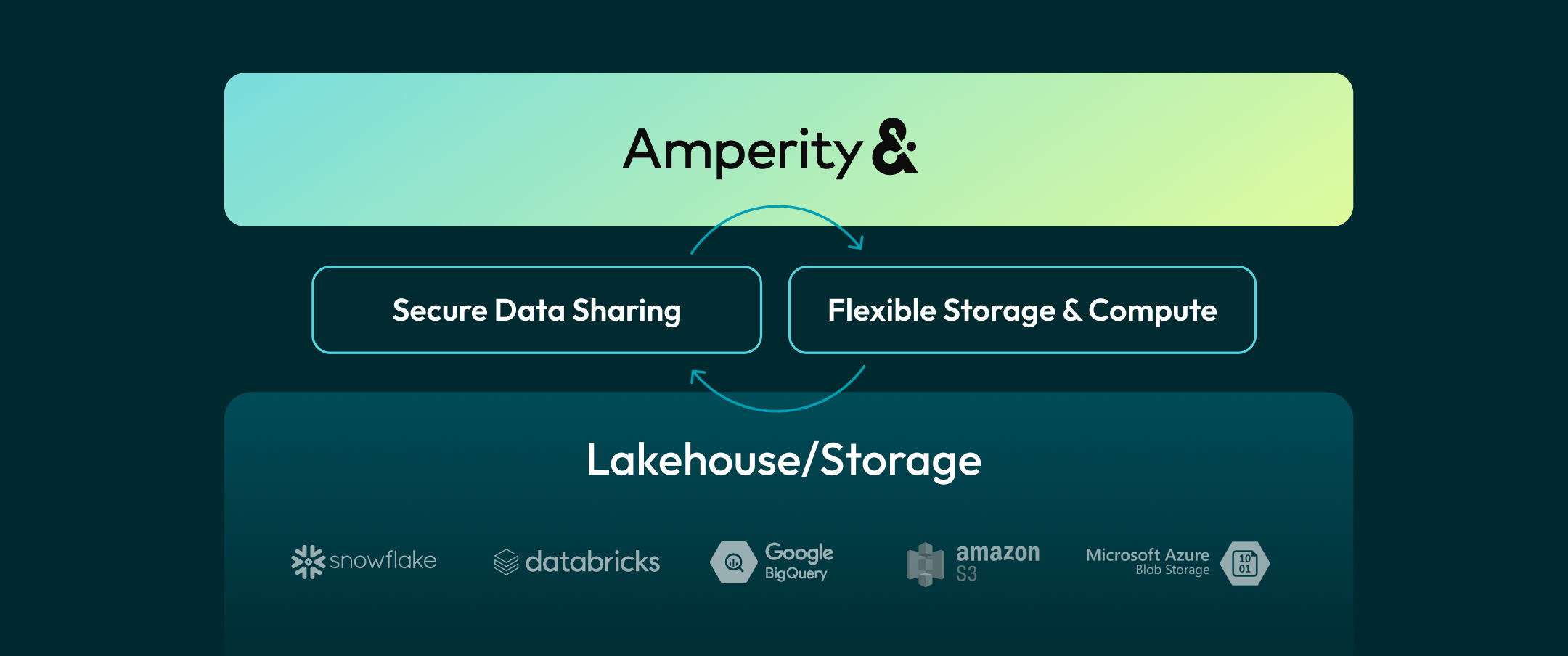

Bring your own storage (BYOS)
Your raw customer data stays in the storage layer you control, whether that is S3, Azure, or your cloud of choice.

Bring your own compute (BYOC)
Supported batch workloads, Identity Resolution, domain tables, database generation, queries, and segmentation execute in your compute. Real time and activation stay Amperity-managed.

Data sharing, Amperity Bridge
Amperity Bridge connects your lakehouse with minimal data movement, so resolved context reaches activation inside your existing security and governance scope.
Warehouse-native tools move your data to add context. Amperity adds context where your data lives.
Managed Identity Resolution, not just activation
Reverse ETL moves modeled data into downstream tools. If your setup does not include identity resolution, that layer still needs to be provided. Amperity combines managed identity resolution with activation. Amperity resolves identity at scale, including profiles, households and persistent IDs, then activates.
Identity resolutionCustomer intelligence connected to your lakehouse
Supported batch workloads can run on your Databricks compute when BYOC is enabled. Predictive models and AI services remain Amperity-managed.
Less engineering, more accurate identity
Building production-grade identity resolution in-house is a long, costly project with ongoing upkeep. With Bring Your Own Compute enabled, Amperity runs supported identity-resolution workloads in your Databricks environment, so your engineers spend less time building and maintaining matching logic.
Purpose-built for consumer identity
Consumer identity is more complex than enterprise identity. More touchpoints, more fragmentation, more signal to reconcile. Amperity was built specifically for that complexity, and runs across your existing cloud, storage, and activation stack without lock-in.
A lakehouse-native strategy with expanding support.
Databricks CDP
Build on Databricks with Amperity. Resolve fragmented customer records, share profiles, and activate audiences through supported marketing tools.
Snowflake CDP
Build on Snowflake with Amperity. Resolve fragmented customer records, share profiles, and activate audiences through supported marketing tools.
BigQuery CDP
Build on BigQuery with Amperity. Resolve fragmented customer records, share customer profiles, and activate audiences through supported marketing tools.
AWS CDP
Build on AWS with Amperity. Connect Amazon S3 data, resolve customer identity, build audiences, and deliver customer context to supported destinations.
Recognized by the platforms we run on
Real outcomes from brands running Amperity on their lakehouse.

4 days to a full Customer 360
From data ingestion to a trusted, unified customer profile, with 100% data trust across marketing, data science, and data teams from day one.
Read story
297M records unified into one governed member record
37 disconnected sources resolved, 50+ hours a week saved in manual reconciliation.
Read story
5,000 hidden high-value fans discovered
61.5% cleaner database. A fan view for every channel, enriched with lifetime value, top-10% flags, and passholder status.
Read story
71% of top customers shop across channels
Databricks Data Intelligence Platform plus Amperity Bridge identified 71% of top customers shop across channels.
Read storySupported workloads run inside the security and governance boundaries you operate. Nothing changes what you control.

Request a personalized demo
Your governance team doesn't need a new exception. Amperity fits inside the one you already have.
Request a demoDownload guideFrequently asked questions
Does Amperity copy data out of your lakehouse?
Which lakehouses do you support?
Does Amperity replace Databricks or Snowflake?
What runs in our environment, and what does Amperity manage?
Is Amperity a composable CDP?
What do we keep control of with BYOC and BYOS?
Is our customer data used to train models?
Recommended Content

Solution Brief
How to Establish a Foundational Customer Data Stack
Build your customer data stack in the right order, so every dollar in marketing, media, and AI actually performs.

Blog
Nov 23, 2026
Entity Resolution on Databricks: Options for Customer Data Teams
Compare custom rules, libraries and connected platforms for Databricks entity resolution, including quality tests and operating ownership.

Blog
Nov 20, 2026
Identity Resolution in Snowflake: Build It, Buy a Native App or Share Data
Compare custom matching, Snowflake Native Apps and connected identity platforms by quality, processing boundaries and operating ownership.